Clinical knowledge

Articles, blog and research updates

Read about OCD and treatment in clinical articles, blog posts and research updates.

Showing 29 results

Filters

Filter by content type (4)
Tags (108)
Authors (12)

Results

Illustration of a football pitch viewed from above, with a goal at each end

Jesper Krogholt

Clinical psychologist licensed in Denmark and OCD specialist

Blog

Go on the offensive against OCD

Many people have played by OCD’s rules for far too long. The aim is not to defend against OCD more effectively, but to change the game and go on the offensive.

A polar bear in water holding its paws in front of its eyes

Jesper Krogholt

Clinical psychologist licensed in Denmark and OCD specialist

Research news

Intrusive thoughts are common across cultures

An international study shows that unwanted intrusive thoughts occur across cultures. This research news item separates the study findings from the OCD specialist’s clinical perspective.

Illustration of Hamlet holding a skull with the text 'To be or not to be–'

Jesper Krogholt

Clinical psychologist licensed in Denmark and OCD specialist

Article

To accept or not to accept

Acceptance in OCD treatment is not about accepting what an obsession says. It is about meeting the thought in a way that stops OCD from deciding what happens next.

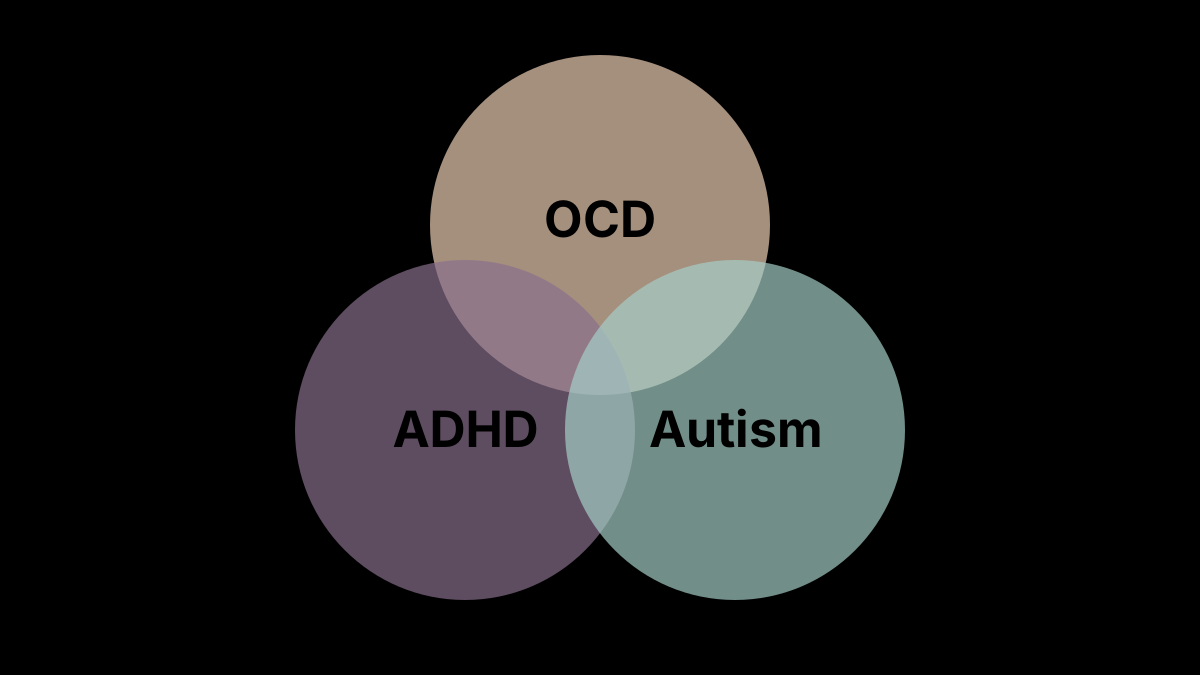
Venn diagram showing OCD, ADHD and autism

Ditte Mortensen

Licensed psychologist, PhD

Article

Autism, ADHD and OCD: How do you know if there is more going on than OCD?

When OCD appears alongside signs of ADHD or autism, the picture can become unclear. This article explains differences, overlap and signs that something more than OCD may be involved.

Illustration of a person between dark thoughts and a bright landscape

Jesper Krogholt

Clinical psychologist licensed in Denmark and OCD specialist

Blog

OCD, overthinking and social anxiety

What is interesting about OCD, overthinking and social anxiety is not simply that they often occur together. They can share the same underlying mechanism: an attempt to achieve certainty through thought, analysis and control.

Illustration of a calm armchair in a warm therapy room

Jesper Krogholt

Clinical psychologist licensed in Denmark and OCD specialist

Blog

When exposure for OCD is misunderstood

What matters is not how uncomfortable an exposure can be made, but whether it is carefully targeted and helps break the OCD cycle rather than becoming part of it.

Silhouette of a person sitting with their head in their hands

Mørk & Korch

Graduate psychology student

Article

Taking care of yourself as a relative in everyday life with OCD

About guilt, stress and vulnerability, the role of relatives and the right to a life alongside OCD.

Four empty seats around a dining table with crockery, coffee cups, work papers and a school bag beside one chair

Mørk & Korch

Graduate psychology student

Article

When OCD controls family life: a day with the Jensen family

In the Jensen family, OCD's demands extend to a sibling's life, the parents' sleep and work, and the family's ability to spend time together.

A woman becomes absorbed in decorating a piece of pottery

Nicolai Korch

Graduate psychology student

Article

The importance of mood in OCD

OCD often thrives in seriousness, heaviness and narrowing of life. This article looks at how mood, engagement and positive activity can create better conditions for change.

Stream of thoughts: a dark figure surrounded by many question marks

Michelle Ingemann Mørk

Graduate psychology student

Article

Doubt and irrational thought processes in OCD

Doubt is central to many OCD patterns. This article explains how irrational doubt can be given unhelpful meaning and become difficult to leave alone.

Woman surrounded by many thought bubbles

Nina Hviid

Graduate psychology student

Article

Can we learn to think differently? Part 2

Part two focuses on basic assumptions and rules for living: the underlying patterns that can limit psychological wellbeing and maintain difficult reactions.

Woman surrounded by many thought bubbles

Nina Hviid

Graduate psychology student

Article

Can we learn to think differently? Part 1

Can we learn to think differently and thereby change how we feel and act? Part one introduces the connection between situations, thoughts, feelings and actions.

Faces and figures in an abstract blue composition

Nanna Ladefoged

Graduate psychology student

Article

Sexual obsessions in OCD: three cases

Meet Sandra, Søren and Karsten in three cases involving sexual obsessions, checking bodily reactions, rumination and avoidance.

Women’s faces amid abstract blue forms

Nanna Ladefoged

Graduate psychology student

Article

OCD can take many forms: three cases involving contamination, symmetry and checking

Meet Bente, Peter and Lis in three cases involving dirt and contamination, order and symmetry, and checking behaviour.

Pale green plant tendril curling into spirals

Jesper Fredslund Pedersen

Graduate psychology student

Article

Internalisation in OCD

When thoughts are internalised, they can start to feel as though they say something fundamental about who a person is. This article uses an example to show how the process can maintain OCD.

Close-up of an eye with a blue iris

Lærke Yssing

Graduate psychology student

Article

“But that just doesn’t make sense …” – a personal account of learning to understand OCD

Lærke Yssing reflects on her first encounters with OCD and uses her own fear of spiders to make the anxiety involved easier to understand.

Illustration of a woman being pointed at from all directions

Lærke Yssing

Graduate psychology student

Article

Feeling ashamed of having OCD: a double problem

Many people with OCD struggle both with the symptoms and with shame about their thoughts or about having OCD. Shame can add to the burden and make it harder to seek help.

A white silhouette whose head is filled with symbols and tools

Jesper Fredslund Pedersen

Graduate psychology student

Article

Externalisation in OCD

When OCD feels like part of the self, it can become hard to act freely. This article explains externalisation as a way to step back from OCD’s demands and stories.

Two adults sitting side by side and talking over a shared notebook

Freja Thomsen

Graduate psychology student

Article

Life as the partner of someone with OCD

Nikolaj talks about being Laura's partner and about how OCD affects their life at home. The interview shows how knowledge and practical tools can change the way a couple manages OCD at home.

A tall, crooked wooden block tower rests precariously on a few lower blocks

Cecilie Juul Hinze

Graduate psychology student

Article

Life with OCD, up close

This personal article gives an up-close view of life with OCD: checking rituals, exposure exercises, support and the small steps that can gradually change everyday life.

Rolled measuring tape symbolising the measurement of anxiety levels in treatment

Freja Thomsen

Graduate psychology student

Article

Cognitive behavioural therapy for OCD

This article introduces key elements of cognitive behavioural therapy for OCD: automatic thoughts, psychoeducation, exposure and response prevention.

Coloured pencils arranged in a circle with their sharpened tips meeting in the centre

Freja Thomsen

Graduate psychology student

Article

OCD and the anxiety system

Thoughts, feelings, bodily reactions and actions influence one another. This article shows how the anxiety system can help explain the many ways OCD presents.

Stairwell seen from above as a visual metaphor for patterns and connections

Cecilie Juul Hinze

Graduate psychology student

Article

Causes of OCD: the cognitive behavioural model explained

OCD can be understood as an interaction between vulnerability, interpretations, distress and compulsions. This article explains the cognitive behavioural model of OCD.

A red carpet continuing through several open doors

Kia Lauridsen

Graduate psychology student

Article

"Am I going crazy?" When OCD symptoms change and shift to new themes

When OCD changes theme, it can feel like something new and more serious. This article explains symptom shifting, and why new thoughts can still be OCD.

Baby lying under a blanket

Jesper Krogholt

Clinical psychologist licensed in Denmark and OCD specialist

Article

OCD around childbirth

OCD around childbirth can involve frightening, unwanted thoughts. This article explains why the distress is often misunderstood, overlooked or kept hidden.

Woman surrounded by repeated questions and symbols representing mental rituals in OCD

Amalie Gersbo-Møller

Graduate psychology student

Article

Mental rituals and Pure O: OCD is more than handwashing

OCD is more than handwashing. Through concrete examples, this article shows how mental rituals can briefly reduce discomfort while maintaining OCD.

A polar bear in water covers its eyes with its paws

Kia Lauridsen

Graduate psychology student

Article

Hidden OCD: why obsessions are often kept secret

OCD can become a hidden disorder when obsessions target what a person feels most ashamed of. This article explains why hidden obsessions do not reveal the person’s values.

Shadows of three people holding hands on a pale rock surface

Kia Lauridsen

Graduate psychology student

Article

“Should I check that for you?” When the family accommodates OCD

When family members help with rituals, reassurance or avoidance, their help can become part of the OCD pattern. This article explains how support can be changed gradually.

A person walking away from a door while a keyhole and question mark illustrate later OCD doubt

Jesper Krogholt

Clinical psychologist licensed in Denmark and OCD specialist

Article

When OCD tries to prevent future doubt

Checking can become an attempt to create evidence for later. This article explores how monitoring and memory evidence can strengthen doubt and keep OCD going.