

Autism, ADHD and OCD: How do you know if there is more going on than OCD?

Audio: Listen to the narrated version of the article.
Although OCD is different from ADHD and autism, there are also many similarities, and it can be difficult to tell them apart. In this article, we try to make it clearer how ADHD and autism can present, and which signs may point to more than one diagnosis being present.
Introduction
Most people who have experienced OCD at close range have probably wondered where it comes from. It is often difficult to give a clear answer, but for a minority of people it may be linked to also having ADHD or autism.
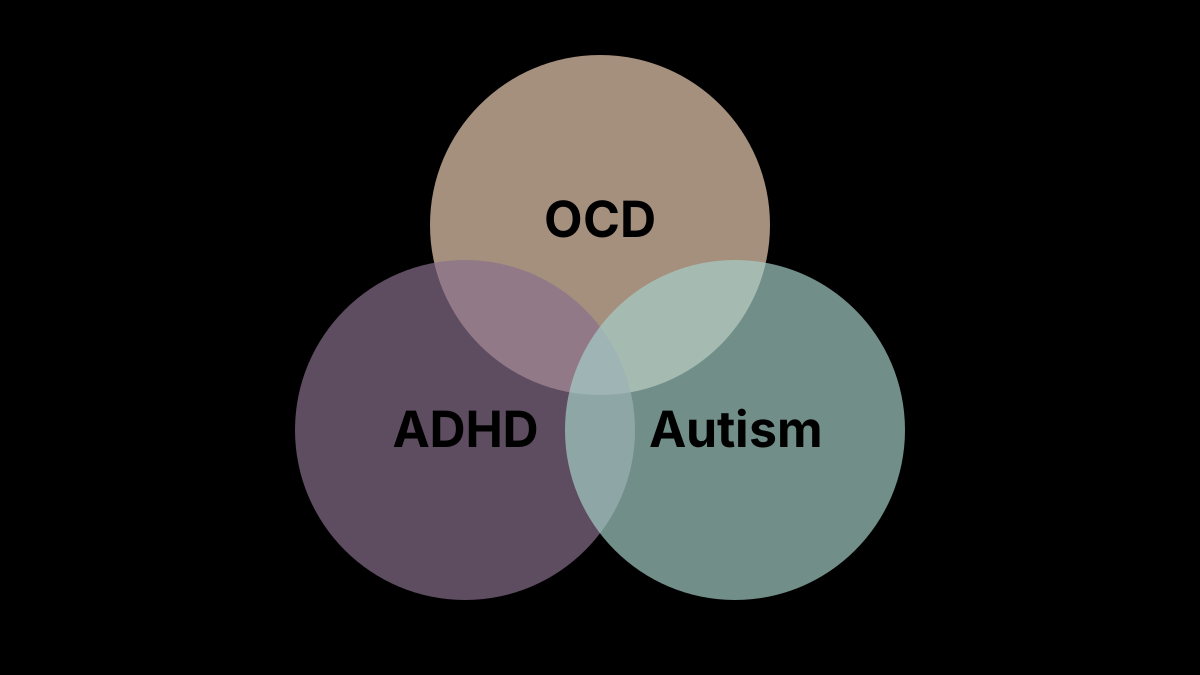
An American review of OCD research suggests that around 16% of people with OCD also have ADHD, while 6% have autism. By comparison, ADHD occurs in 3-5% of the general population and autism in 1-2%. This means that if you have OCD, there is a higher likelihood that you also have ADHD or autism.
Where OCD is a mental health disorder that can often be treated successfully, ADHD and autism are better understood as different ways of functioning that stay with the person throughout life. That difference is not necessarily a bad thing, but it can be difficult to manage if you do not understand it. If you know that you have ADHD or autism, you can learn what it means and navigate according to the strengths and vulnerabilities it brings. If, on the other hand, you simply feel different without knowing why, it is often difficult to use that understanding constructively. It can therefore be a great help to clarify whether, in addition to OCD, there are also signs of ADHD or autism, or both.
Although OCD is different from ADHD and autism, there are also many similarities, and it can be difficult to tell them apart. In this article, we try to make it clearer how ADHD and autism can present, and which signs may point to more than one diagnosis being present. For clarity, we begin by briefly recapping what OCD is.
What is OCD?
OCD is a mental health disorder characterised by unwanted thoughts that are difficult to shift attention away from, and actions that feel very difficult not to perform. The actions can be physical, such as sanitising your hands again and again, but they can also be purely mental, such as specific thoughts or phrases you feel you have to repeat in your mind. OCD thoughts and actions are often connected to difficult emotions such as anxiety and shame. OCD can appear both in childhood and during adult life, and with the right treatment it is often possible to become free of OCD.
ADHD is generally characterised by impulsivity, hyperactivity and difficulties controlling what you focus on. You can have ADHD without visible hyperactivity - this has sometimes been referred to as ADD. ADHD can make it difficult to concentrate on what you need to do, and can also make it harder to manage your thoughts. ADHD is a neurodevelopmental condition that a person has throughout life. It is therefore not a mental health disorder that can be cured, but rather a different way of functioning. This is why it is also often described as neurodivergence rather than as a disorder.
What is neurodivergence?
- Neurodivergence is a term used to describe the idea that a person can be different without being ill. It helps avoid words such as "normal" and "abnormal". A neurodivergent person has a lifelong difference, such as autism, ADHD or dyslexia. People who do not have diagnoses like these are described as neurotypical. Both neurodivergent and neurotypical people can also have diagnoses such as OCD or anxiety.
OCD & ADHD - the same symptoms can cover different things
OCD often involves difficulty letting go of unpleasant thoughts, known clinically as obsessions, and difficulty resisting the urge to perform certain actions, known as compulsions, to reduce discomfort. In a similar way, people with ADHD may find it difficult to control their focus and impulses. Although there are clear differences between OCD and ADHD, there are also similarities that can make it complicated to work out whether a person has one, the other, or both.
Take Konrad, for example, who is 10 years old. He finds it hard to listen in school and keeps getting up from his seat without permission. This could point in several different directions, depending on the explanation. It may be that:
- He has racing thoughts about all sorts of things and restlessness in his body, which makes it impossible to sit still.
- He is preoccupied with worries and closely monitors everything he touches because he fears bacteria. He keeps getting up to check whether there is anything dirty on his chair.
- He has racing thoughts about all sorts of things, and now those thoughts have attached themselves to bacteria, which he has become afraid of and finds hard not to check.
All three explanations are possible. The first points towards ADHD, the second towards OCD, and the third towards a combination of both.
For an adult example, consider Signe. After a period of stress, she has developed intense and frightening thoughts about harming other people. These thoughts fill her with so much fear that she isolates herself so that she will not be a danger to anyone. Based on this description, it points towards OCD. If Signe has also had many thoughts about all sorts of things since childhood, has often been told off for talking too much, and now changes jobs every year because it becomes too hard to concentrate once tasks become familiar, it may be relevant to consider whether both OCD and ADHD are involved.
It is therefore important to ask more questions to clarify whether there may be more going on than OCD alone. We return to this topic later.
OCD and autism
Like ADHD, autism is a lifelong neurodevelopmental condition or form of neurodivergence. The official term, autism spectrum disorder, covers a group of conditions that can look different, but which have in common that a person experiences challenges understanding and taking part in social situations, as well as inflexible and repetitive patterns of behaviour and interests. For example, a person may have all-consuming interests that few others share, need things to happen or look the same way every time, or speak at length about something that interests them without noticing that they have interrupted a conversation or that others are bored. The autism spectrum is broad, and many autistic people function in other areas in similar ways to people without autism.
OCD & autism - the same symptoms can cover different things
On the surface, people with OCD and autism may have several things in common, which can make it difficult to distinguish between the two. For example, things may need to look or happen in exactly the same way each time, a person may repeat the same action many times, or they may repeatedly ask questions they already know the answer to. But beneath the surface, there may be very different reasons for what we see.
One example is Luna, who is 9 years old and needs her toys to stand in exactly the right way on the shelf. Because of this, she finds it hard to stop rearranging them. She asks her parents again and again whether they think the toys are exactly as they usually are, even though the answer is always the same. Again, there may be explanations that point in different directions:
- She is afraid that something will happen to her family if she does not place the toys exactly right. She therefore also checks many times with her parents that she has done it well enough.
- She finds joy and calm in repeatedly arranging the toys exactly right. If her parents interrupt her, she experiences this as uncomfortable and asks the same question repeatedly to manage her stress and discomfort.
- She needs fixed routines and repeats actions across many different areas. Most of the time this feels safe and pleasant, but in some situations it is because she fears that something bad will happen if she does not do it.
As before, all three explanations are possible, but the first points towards OCD, the second towards autism, and the third towards a combination of both.
An adult example could be Sebastian, who has developed anxiety about accidentally calling other people terrible things when he speaks to them. Before he is going to be with other people, he performs complicated finger-tapping actions that have to be done exactly right to protect him from saying something wrong. As described here, this points towards OCD. If, however, Sebastian has experienced throughout life that social situations are difficult, or if he has repeated, uniform actions in many other contexts, it is relevant to consider whether autism may also be involved.
Deeper similarities: Executive functioning difficulties
On the surface, OCD can therefore look like both ADHD and autism, just as ADHD and autism can look like OCD. Research shows, however, that there are some deeper underlying difficulties that all three have in common: difficulties with what are known as executive functions.
Executive functions cover a range of thinking processes that are useful to understand. Knowing about them can make it easier to understand how apparently different challenges are connected.
Executive functions
Executive functions are the thinking processes we use when we consciously control our focus and actions. This applies both to what we want to focus on and how we want to act, but also to what we do not want to focus on or act on. Examples include trying to concentrate on a boring task at work, or deciding not to eat the next piece of chocolate.
Much of the time, we are not especially conscious of our thoughts and actions. We are creatures of habit and do what we usually do. You could say that executive functions are what we use when we need to switch off autopilot and consciously steer our thoughts and actions.
Executive functions develop until the brain is fully developed, but adults can still improve them through training.
Executive functioning difficulties
When a person has difficulties with executive functions, this can affect all the situations where they need to manage what they focus on, concentrate on something, or shift from automatic behaviour to more conscious action.
People with ADHD or autism are born with executive functioning difficulties and may have them throughout life, but everyone experiences executive functioning difficulties at certain times. These may be short periods, for example when it is hard to concentrate or you become more irritable because you have not slept enough. They may also be longer-lasting periods, for example if you are stressed or have a mental health disorder such as OCD. In relation to OCD, it makes sense that it can be difficult to concentrate and remember what you need to do if you are constantly using mental energy to remember what you have touched or to repeat phrases in your mind.
If you have developed executive functioning difficulties because of a period of strain, they usually improve more or less when you get better. If you were born with executive functioning difficulties, you can train them so they become less of a problem, but they rarely disappear completely.
Executive functioning difficulties can be hard to understand because the concept feels abstract. We have therefore gathered some concrete examples of how they can look, both when they occur in connection with OCD and in other contexts. It is a fairly long list, but we have included many examples to show how differently they can present. It is common to have difficulties with some executive functions while other functions work in an entirely ordinary way.
Difficulties controlling and sustaining focus, such as:
- when you need to concentrate on something that is not very interesting, such as homework.
- when you need to remember to do something you do not usually do, such as buying milk on the way home or refraining from an OCD action.
- when you need not to give attention to irrelevant sensory impressions or thoughts, such as not being distracted by unrelated sounds, worries or OCD thoughts.
- when you need to shift from one activity to another, such as turning off Netflix to go to bed or stopping rumination and OCD actions.
Difficulties organising and prioritising, such as:
- when you need to distinguish between relevant and irrelevant information, such as when you need to understand a topic in limited time or avoid bringing irrelevant information into risk assessments.
- when you need to change your approach to something, such as when you cannot solve a problem in the way you usually do, or when you need to let go of an OCD strategy.
Difficulties regulating emotions and actions, such as:
- when you need to avoid acting on impulses, such as not interrupting or not performing an OCD action.
- when you need to tolerate emotions, such as not becoming completely overwhelmed by anxiety, rage or joy.
Difficulties noticing and reflecting on yourself, such as:
- being aware of how you affect other people, such as noticing whether others are bored.
- being aware of how you are doing yourself, such as noticing whether you are tired, hungry or anxious.
Difficulties with complex reflection, such as:
- when you need to hold several things in mind at once, such as solving complex tasks or considering several alternative explanations for why something happens.
What questions can you ask yourself?
In this section, we look more closely at which questions you can ask yourself to clarify whether you might have autism or ADHD.
If you have read the examples and recognise yourself or a relative in some of the descriptions, you can start by asking yourself two overall questions. The questions are written in the first person, but you can also use them to reflect on a child or another relative:
- Do I experience social and/or executive functioning difficulties in contexts other than OCD?
- Have these difficulties been present since childhood?
If the difficulties you experience mainly occur in connection with OCD and have not been present since childhood, then as a general rule we would not be talking about autism or ADHD.
If the answer to the questions above is yes, you can move on and consider the questions below. We have not divided them into autism and ADHD, but with a few exceptions have chosen questions that are relevant to both.
Questions for reflection
- Is it difficult for me to take part in social situations, for example because I end up talking too much or find it hard to talk about things that do not interest me?
- Do I have many thoughts and ideas about all sorts of things at the same time most of the time?
- Can I become absorbed for hours in things that interest me, while at the same time finding it impossible to get started on things that interest me less?
- Do I forget things such as eating, drinking or going to the toilet when I am occupied with something?
- Do I often forget appointments and other important things?
- Do I sometimes suddenly burn out completely with a feeling that everything is unmanageable?
- Do I do best with fixed routines where things happen in the same way every day?
- Do I often need to shield myself from sensory impressions so they do not become disturbing or overwhelming?
- Is it difficult for me to sit still without moving my legs, fiddling with my hair, clicking a pen or similar?
- Do I often become so overwhelmed by emotions that I react before I think?
- Do the difficulties make it hard to manage school or work and still have enough energy for everyday life?
- Do the difficulties make it hard to maintain friendships or spend time with family?
It is important to emphasise that finding out whether you have ADHD and/or autism requires a thorough assessment, and there are more aspects to it than we cover here. If you have answered yes to several of the questions and feel burdened by it, however, it may be a sign that it is relevant to explore further. You can do this, for example, by talking to a psychologist or doctor about your reflections. You can also show the questions to someone who knows you well and see whether they recognise some of the same things in you.
Summary
This article has focused a lot on diagnoses and how they overlap. Diagnoses are relevant if they provide a better understanding of the difficulties you experience, or point towards how you can best get help. It is also important to say that diagnoses are not necessary in order to understand yourself and work with the challenges you have. At the same time, there are many other aspects to every person than those that can be described by diagnoses.
Whatever the situation, treatment works best when it is adapted to the individual person. Diagnoses can of course help identify the best method, but they are one aspect among many that influence how we plan treatment.
Learn more
You can read more about autism on the NHS website: What is autism?
You can read more about ADHD on the NHS Inform website: Attention deficit hyperactivity disorder (ADHD)
You can read more about executive functioning difficulties here: What are executive functions?
If you would like to go deeper into the research, you can read about executive functions and OCD and about OCD comorbidity.