
Complete the Danish PDF
Download the fillable test directly. You do not need an account, and you can save your answers on your own device.
Download PDFMy courses
Log in to the course portal to view the courses you already have access to.
Go to my coursesOCD test
Download the Danish BOCS test directly as a PDF, or use the free Danish video guidance.
Validated self-report OCD test
BOCS is a validated self-report test that maps OCD symptoms, avoidance and their impact on daily life. The current test and video guidance are in Danish.
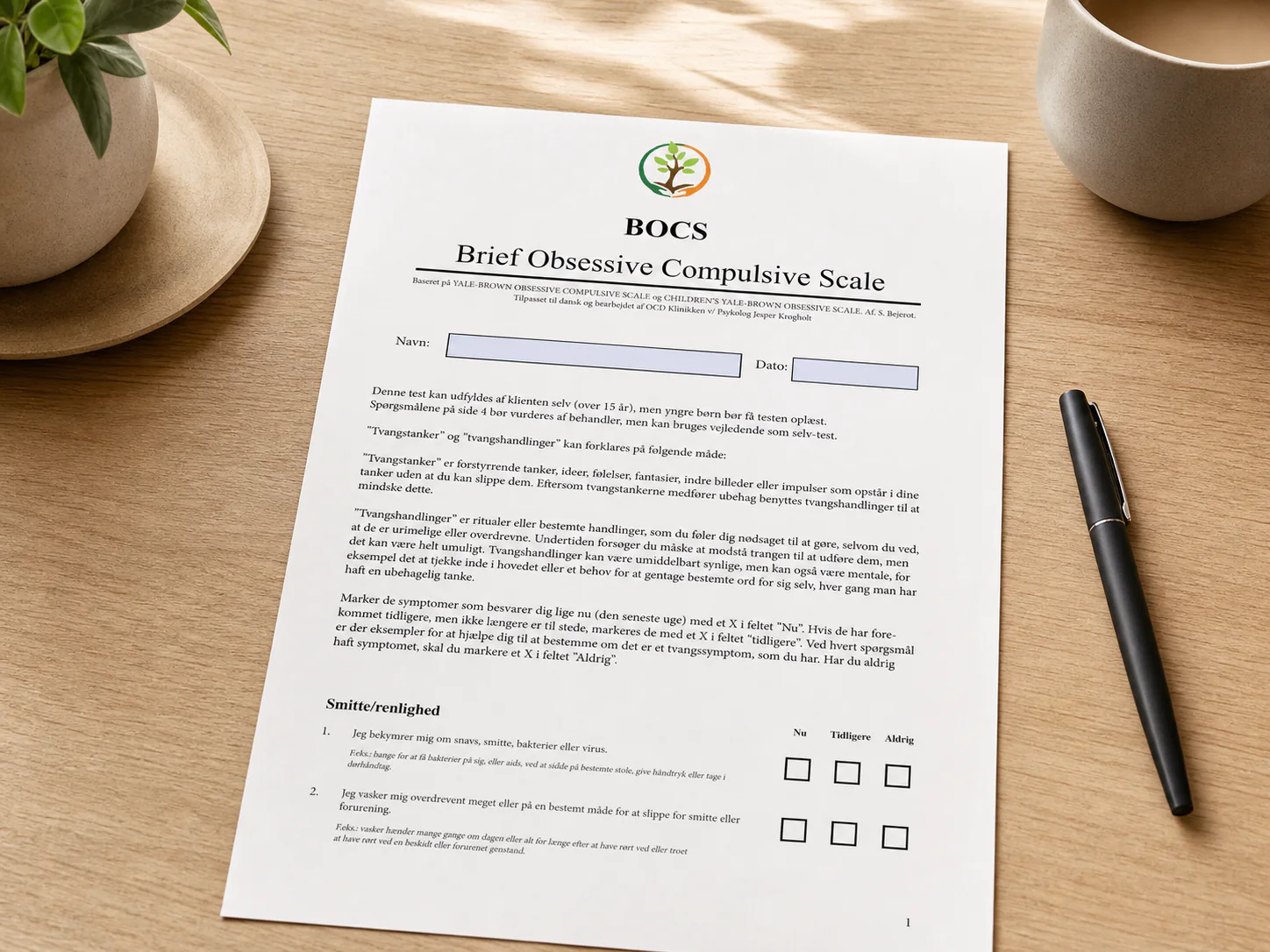
The BOCS test combines a symptom checklist with six questions that assess the severity of your symptoms and their impact on daily life. You can complete the PDF on your own or use the Danish video guidance for support.
You can complete the PDF directly or use the Danish video guidance for support. Both options use the same test and scoring.
The first part maps different forms of obsessions and compulsions. You mark symptoms that affect you now, symptoms you have experienced in the past and symptoms you have never had.
The final part assesses six areas during the past seven days:
Together, the answers produce a BOCS score from 0 to 24. The score summarises symptom severity and shows which areas are most affected.
Answer according to the past seven days, including today. The test covers both visible actions and mental rituals that other people may not see.
Select symptoms that affect you now or have affected you in the past. If something important is not included, the PDF provides space for you to describe it in your own words.
Choose the response that fits best. You do not need a perfect answer. A reasonable first estimate is usually more useful than analysing each question at length.
Add the points from the six questions. You may want to save the test if you plan to compare results over time or use it as the basis for a conversation.
A higher score means that the symptoms have a greater impact. Two people with the same score may still be affected in different ways, so consider both the number and the symptoms and situations behind it.
Use the result to get an overview of:
If your answers concern you or the symptoms restrict your daily life, you can take the completed test to a doctor or psychologist. You may also book directly with OCD Klinikken; you do not need a referral or prior approval.
BOCS stands for Brief Obsessive Compulsive Scale. It was developed by psychiatrist Susanne Bejerot and colleagues, drawing on the established Y-BOCS and CY-BOCS scales. The Danish version was adapted by OCD Klinikken and psychologist Jesper Krogholt.
BOCS combines symptom mapping and severity assessment in one tool. It can be used as a self-report test, as the starting point for a clinical conversation and to track changes over time.
Young people aged 15 and over can usually complete the test themselves. For younger children, an adult can read the questions aloud and help explain the wording. As far as possible, the answers should reflect the child's own experience during the past seven days.
No. The PDF is opened and completed on your own device, and your answers are not sent anywhere automatically. You can save or print it and choose whether to share it with your doctor, a psychologist or OCD Klinikken.
You do not need an account to download or complete the PDF. The Danish video guidance currently sits in OCD Klinikken's course system and requires you to create a free user account. You can choose the option that suits you.
The PDF gives you direct access to the Danish test and can be completed without an account. The video guidance takes you through preparation, completion and how to understand the result. Both options use the same test, and you do not need to use both.
Add the points from the six questions to produce a total score from 0 to 24. Also consider the symptoms, avoidance and areas of daily life behind the number. You can use the result to describe your current symptoms, compare changes over time or as the basis for a clinical conversation.
Yes. A completed test can make it easier to identify what affects you and provide a concrete starting point for the conversation. You do not need to complete the test before booking or attending your first consultation.
Understand the signs
Read about visible and hidden symptoms, mental rituals and avoidance.
Next step
See how to contact the clinic, book directly and prepare for a first consultation.